
A Weekly Witness: Thoughts on Ministry, Justice, and Life Together from your Presbytery Leader
Like you, I am saddened and crushed by the start of the school year beginning with a mass shooting.
The late Presbyterian activist and pastor James E. Atwood first introduced me to the image of rising gun violence being like a flood that rises over sandbags—we have normalized that we somehow live in a floodplain that makes regular flooding acceptable, and as a way to avoid direct conversation of where the water is coming from and why there is so much water here, we blame the sandbags. In the particular situation at Annunciation Catholic School in Minneapolis on August 26th, I notice how blaming a demographic that represents 1 percent of the population, that in turn represents less than1 percent of all mass shooters, is blaming a single sandbag for not stopping a sea of floodwaters. Our (solvable) problem with gun violence as an American society will continue to remain if we continue to find sandbags to blame while welcoming the floodwaters to exist in the first place. To study more on our country’s singular and unique embrace of gun violence, I highly recommend any of James E. Atwood’s books: “America and Its Guns: A Theological Expose” (2012), “Gundamentalism and Where It Is Taking America” (2017), and “Collateral Damage: Changing the Conversation about Firearms and Faith” (2019). Our presbytery also has a Public Witness Team that curates resources and conversation spaces around gun violence and gun violence prevention, like the November 17, 2022 workshop called “Gun Violence Prevention: How Might Congregations Respond?” led by Rev. Dr. Susan Andrews. One of our greatest resources in this conversation is each other.
My heart lately has been drawn to pastoral care—when we respond in care for those weeping who we actually know and love—and how we will do that when it happens to us. How can we respond in care when we are also numb, angry, and frustrated with news of ongoing gun violence? The numbness I am feeling about yet another mass shooting, tied with my frustration with our elected officials, can limit my own sense of power to do anything and disrupt my ability to care for others. When feeling frozen, I am reminded of the opportunity to start with ourselves even as we connect with the community, in order to find our footing and momentum, our voice and power.
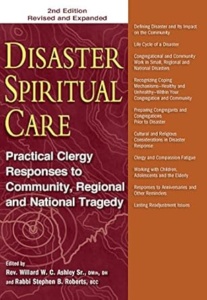
There is a book I have really valued called “Disaster Spiritual Care: Practical Clergy Responses to Community, Regional, and National Tragedy” 2nd Editon (2008, 2017) that has seen frequent movement on my bookshelf over the years. The last chapter asks, “What do we need to be effective?” and lifts up 7 C’s in our pastoral care work when we are called to serve those people directly impacted by disaster and tragedy. I wanted to share them with you here to spark imagination in what our response may look like when disaster strikes and we are positioned to respond directly:
Competence: This is an honest ask of “Does your health, emotional well-being, and state of mind allow you to respond to this particular disaster? Are you starting from a place of peace and with a rested body so that you can actively listen to another? Competence is the starting point.” (372)
Community: It is important “to remember that disaster response is a team effort. This work involves collaboration, and coordination between multiple agencies and various care providers in medical care, social work, government, legal aid, and many others…Are we able to connect [survivors] with the right people in the community to be of help?” (372)
Consent: Establishing consent in showing up on site at a disaster can help keep a bad situation from getting worse. “Your presence is not ministry if you are not wanted there” (373). It also includes touch: “We ask, “Can I hug you? Can I touch you? Do you want water or a tissue? Would you like to talk?” This honors the power of those most impacted by disaster and tragedy.
Confidentiality: When invited into the work of a disaster, “we are invited in to witness people at their most vulnerable moments in life…You may be amazed at confessions or what people in crisis may admit to a spiritual care provider” (373). Meeting each other at depths we may have never seen before creates a certain responsibility of care.
Curiosity: Curiosity is way to notice where and how we can be present with each other. “Curiosity is a permission slip to communicate. We engage in more listening than talking. We listen with ears, eyes, and heart. We are not to be voyeuristic…Are you curious enough to want to know how you can be of help? Curiosity unites both the storyteller and the listener into a shared sacred moment” (374).
Compassion: Compassion can be a connection point where head, heart, and body come together. “Compassion is the force that drives us to help others, particularly in disaster response. It is the voice within our hearts that reaches out to a soul in despair to say, “You are not alone.”
Closure: Finding closure where we can (even by the day, before we pick it back up again) can help us avoid compassion fatigue and feeling like we aren’t enough. Also, “part of closure is to reflect on what happened in our visit. We embrace an action-reflection model. We reflection through assessment, a process whereby we examine our goals and measurable objectives and evaluate if we achieved what we set out to do” (375).
I pray for those spiritual care providers responding to the mass shooting at Annunciation Catholic Church, and all for those who weep from this violence. May they be centered, grounded, and ready to love and bring presence where and how they need to.
Then my prayer is that tragedy and violence never comes our way.
Then my prayer is that our hearts, minds, and bodies are ready to move when it does.
Ryan
Rev. Ryan J. Landino
Presbytery Leader
Giddings-Lovejoy Presbytery
Email: rlandino@glpby.org
Direct line: 314-409-9002